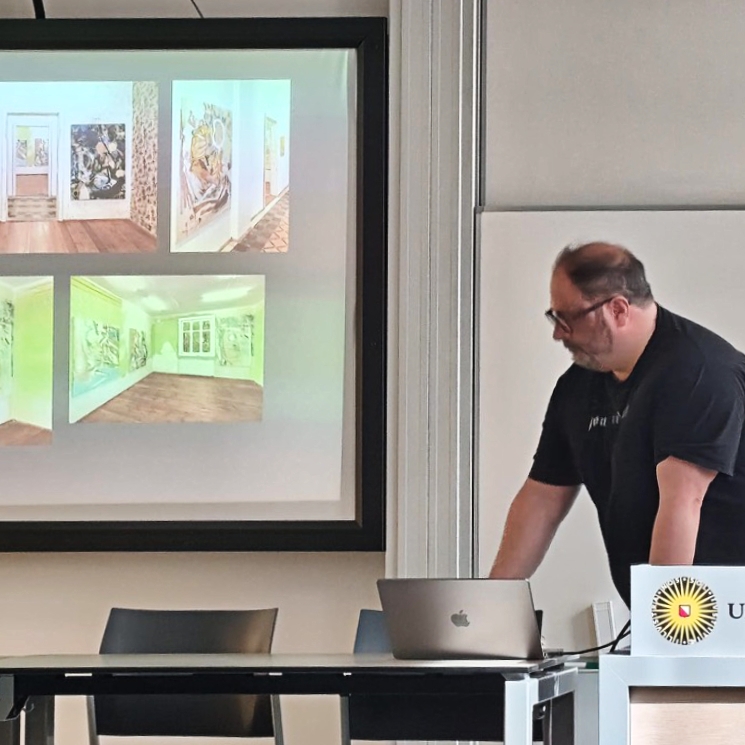


I recently was invited to present my talk, Shadowtime Ecologies: Caterpillars, Bones, and Unstable Landscapes in the Painterly Imagination, at the 11th Biennial EASLCE Conference, Join the Orca Uprising! Nonhuman Resistance and Multispecies (In)Justice, held at Utrecht University from 14–17 April 2026.
Alongside scholars Stefano Rozzoni, Rosamund Paice, and Soolmaz Moeini. I was part of the panel “Resistant Trees and Unruly Landscapes,” chaired by Lena Pfeifer.
In the talk, I shared a recent body of paintings first shown in my 2025 solo presentation, Mum, do caterpillars go to heaven? at C U AT SADKA in Kraków. These works grew out of questions I have been carrying for a while: how to paint ecological and urban metaphysical tension without closing down hope, how to hold death and renewal in the same image, and how to imagine forms of life that exceed the human.
The paintings bring together skeletal figures from my ongoing Earth Being series, unstable landscapes, and a caterpillar moving upward toward a white sun. Trees are held, burned, broken, and growing back. Water rises. Branches snap. Bones merge with trunks and roots. I think of these spaces as unstable on purpose — not quite dead, not quite beginnings.
A question runs through the work: do caterpillars go to heaven? It is a childlike question, but not a simple one. I am interested in what happens when that question is asked seriously, and where it breaks open the limits of human language, belief, and empathy. The caterpillar becomes a figure of vulnerability and persistence, but also of transformation and an other than human reality.
I also discussed the idea of shadowtime to describe the temporal feeling in these paintings: the sense that the future is pressing down upon us while the present experience disorientingly becomes altered. In that space, collapse and renewal are not opposites. They remain entangled. Something keeps trying to rise, even here often resulting in conflicting feelings of both hope and fear in the viewer
Material process is central to how I think through these questions. I dig, cut, drill, scrape, and layer paint with silk, sand, straw, and wood. The image does not arrive cleanly; it has to be worked through. For me, painting is not only a way of representing ecological entanglement, but a way of thinking inside it.
I offered a studio-based painting perspective into this conversation on ecocriticism, multispecies justice, and nonhuman resistance.
Resistant Trees and Unruly Landscapes
Chair: Lena Pfeifer
Speakers:
- Stefano Rozzoni, “Resistant Trees in Simon Armitage’s (Eco)Poems (2019-
2024)” - Rosamund Paice, ‘How many stately oaks must buy a fan?’ Brian Fairfax’s rewriting of Andrew Marvell’s Upon Appleton House”
- Soolmaz Moeini, “Modern Agriculture, Multispecies (In)Justice, and Environmental Migration in Mahmoud Dowlatabadi’s Rural Narratives”
- Michael Markwick, “Shadowtime Ecologies: Caterpillars, Bones, and Unstable Landscapes in the Painterly Imagination”